Observatoire de la chemise — the shirt report
What 82,384 made-to-measure shirts reveal about men's choices
Last updated: 20 July 2026 · Data as of 13 July 2026
Since 2014, LE CHEMISEUR® customers have composed their shirt in total freedom: fit, collar, fabric, cuffs — every detail is a choice. Ready-to-wear sales figures reflect what hangs on the racks; this data reveals what men actually choose when nothing is imposed on them.
The Observatoire de la chemise is LE CHEMISEUR®'s reference data page: 82,384 shirts ordered between July 2014 and July 2026, analysed and published as anonymised aggregates, with full methodology. This page is permanent, continuously updated, and free to cite.
About these figures. They describe LE CHEMISEUR® customers — men who buy made-to-measure shirts online, overwhelmingly in France — not the general population. That is precisely their value: nowhere else in Europe can the real choices of tens of thousands of men, on every detail of a shirt, be observed. No individual data is ever published, and every statistic rests on at least 50 observations.
Contents — The essentials · Fit by age · Standard sizes · The fabric calendar · The perfect fit · In brief · Methodology · Citing this data
The essentials
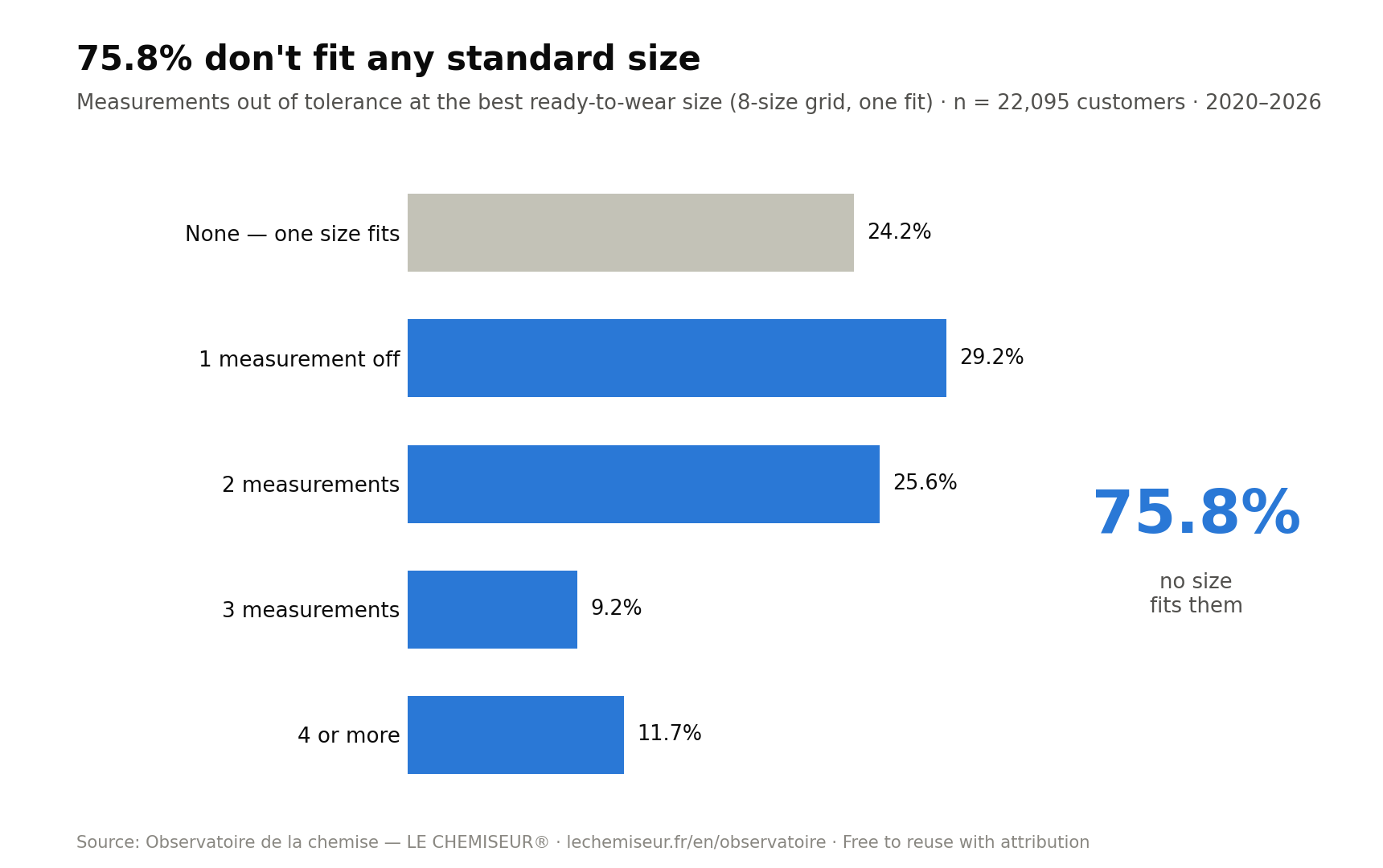
- 75.8% of measured customers do not fit any standard ready-to-wear size.
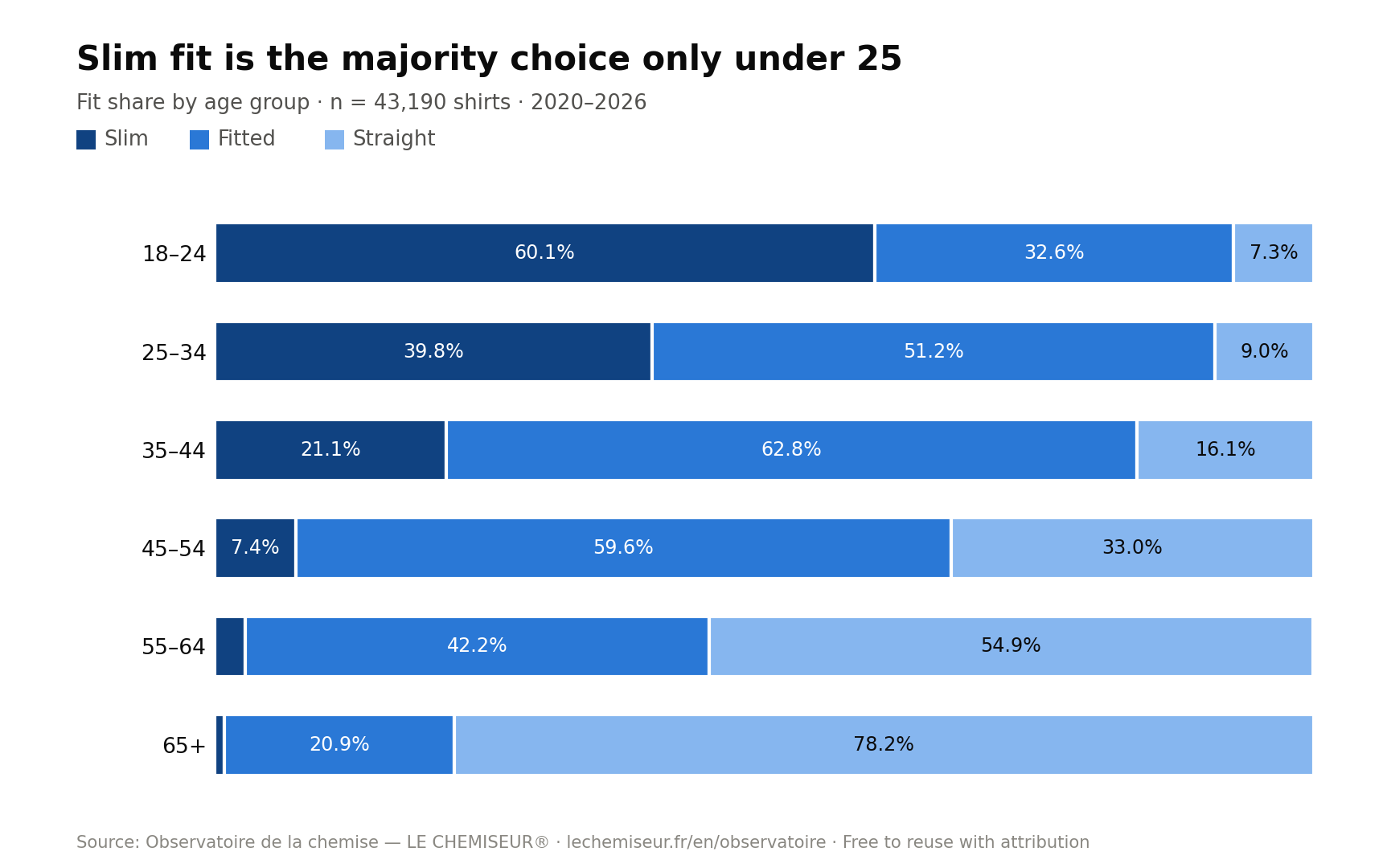
- Slim fit is the majority choice only between 18 and 24. From 25, the fitted cut dominates; after 55, the straight cut.
- Linen passes 10% of shirts ordered in May; flannel, in November.
- 57.6% of customers adjust at least one measurement after their first shirt; the definitive fit is reached in 2 shirts (median).
- 86% of shirts are ordered without a pocket.

1 · At what age do men give up slim fit? At 25.
The slim-fit shirt is the majority at only one age in life: between 18 and 24 (60.1% of shirts). From 25, the fitted cut takes over — the silent standard of the male wardrobe, at 50.6% of all shirts ordered. After 55, the straight cut becomes the majority, up to 78.2% among the over-65s.
| Age | Slim | Fitted | Straight | n |
|---|---|---|---|---|
| 18–24 | 60.1% | 32.6% | 7.3% | 1,542 |
| 25–34 | 39.8% | 51.2% | 9.0% | 8,767 |
| 35–44 | 21.1% | 62.8% | 16.1% | 11,410 |
| 45–54 | 7.4% | 59.6% | 33.0% | 10,976 |
| 55–64 | 2.8% | 42.2% | 54.9% | 7,651 |
| 65+ | 0.9% | 20.9% | 78.2% | 2,844 |
How to read: among shirts ordered by customers aged 18 to 24, 60.1% are slim fit. Age as declared at the first shirt; fit measured on the manufactured garment (see methodology).
Slim isn't dying — the customer base is maturing
Across all orders, the slim-fit share declines year after year (25.8% in 2021, 21.0% in 2026). But among under-35s it is stable and dominant throughout: around 45% in 2021 as in 2026. The overall decline is a composition effect — the customer base is broadening and ageing — not the young abandoning slim.
| Year | Slim | Fitted | Straight | n |
|---|---|---|---|---|
| 2020 | 24.3% | 52.8% | 22.9% | 1,854 |
| 2021 | 25.8% | 51.5% | 22.7% | 6,855 |
| 2022 | 24.8% | 52.8% | 22.4% | 7,874 |
| 2023 | 23.5% | 54.6% | 21.9% | 10,338 |
| 2024 | 24.4% | 52.2% | 23.4% | 11,972 |
| 2025 | 22.6% | 49.2% | 28.2% | 16,169 |
| 2026* | 21.0% | 45.0% | 33.9% | 11,986 |
* 2026: data to 13 July. Manufacturing measurements have been archived since 2020, hence the series' starting point.
To cite — "According to the Observatoire de la chemise by LE CHEMISEUR® (82,384 shirts, 2014–2026), slim fit is the majority only among 18–24-year-olds (60.1%); from 25 the fitted cut dominates, and the straight cut becomes the majority after 55."
2 · Three men in four don't fit any standard size
It is the most important figure in this Observatoire: 75.8% of the 22,095 measured customers fit no common ready-to-wear size. In other words, on a realistic grid of 8 sizes (collars 38 to 45, one fit), there is not a single size for them whose every measurement falls within the tolerances of a well-fitting garment. Only 24.2% of men would be properly dressed by an off-the-rack shirt.
This is not about "non-standard" bodies — it is the standard garment that fails, because it imposes a single silhouette per collar size.
| Measurements failing at the best size | Share of customers |
|---|---|
| 0 — one standard size fits | 24.2% |
| 1 measurement | 29.2% |
| 2 measurements | 25.6% |
| 3 measurements | 9.2% |
| 4 or more | 11.7% |
Reference grid: 8 sizes (collars 38–45), single fitted cut, tolerances of ±1 to ±2 cm depending on the measurement. n = 22,095 customers. Even with an unrealistic grid of 48 templates (16 collars × 3 fits), 65.0% of customers remain outside every standard size.
Where does ready-to-wear fail?
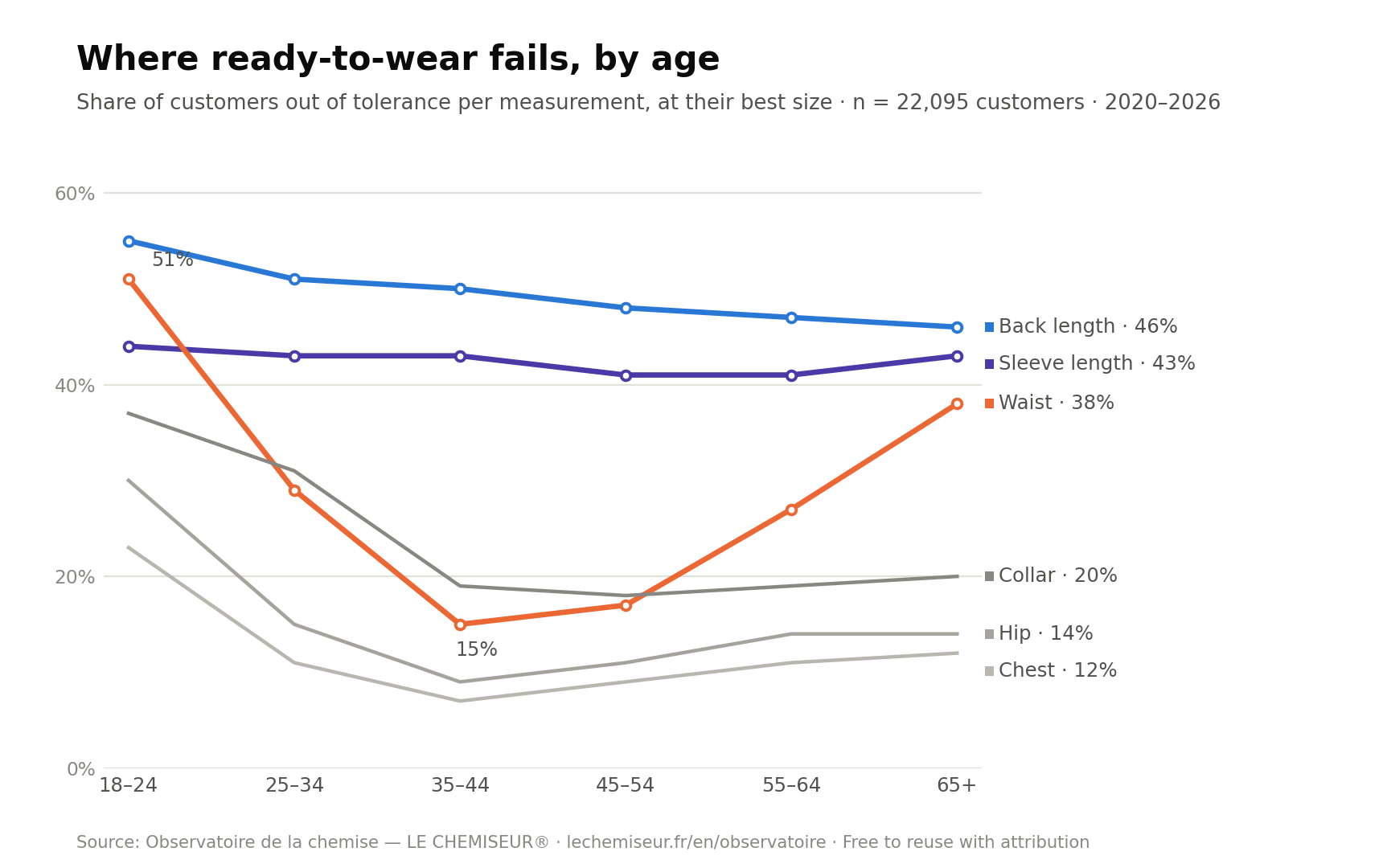
First on lengths: back length (46% of customers out of tolerance) and sleeve length (40%) — mechanical, since ready-to-wear offers a single length per collar size. The waist traps the age extremes: 51% of 18–24-year-olds (a trim waist the straight garment doesn't follow) and 38% of the over-65s.
| Measurement | All | 18–24 | 35–44 | 65+ |
|---|---|---|---|---|
| Back length | 46% | 55% | 50% | 46% |
| Sleeve length | 40% | 44% | 43% | 43% |
| Waist | 24% | 51% | 15% | 38% |
| Collar | 24% | 37% | 19% | 20% |
| Hip | 13% | 30% | 9% | 14% |
| Chest | 10% | 23% | 7% | 12% |
Share of customers whose best standard size remains out of tolerance on each measurement. A customer can fail on several measurements.
The young are the worst served: 94.0% of 18–24-year-olds fit no standard size, against 67.5% at the low point (45–54). The standard garment, cut for an average silhouette, can manage neither broad shoulders over a trim waist nor singular lengths.
| Age | Outside standard sizes | n |
|---|---|---|
| 18–24 | 94.0% | 803 |
| 25–34 | 83.6% | 3,756 |
| 35–44 | 73.0% | 3,905 |
| 45–54 | 67.5% | 3,591 |
| 55–64 | 68.5% | 2,554 |
| 65+ | 76.4% | 1,086 |
To cite — "According to the Observatoire de la chemise by LE CHEMISEUR® (22,095 measured customers, 2020–2026), 75.8% of men fit no standard ready-to-wear size; the first measurements to fail are back length (46%) and sleeve length (40%)."
3 · The fabric calendar: linen in May, flannel in November
Poplin is the backbone of the year: 36.9% of shirts, every month. Around it, two seasonal shifts of clockwork regularity: linen crosses 10% of orders in May, peaks in June (26.9%) and falls back with August; flannel crosses 10% in November and peaks in December (11.3%).
| Month | Poplin | Twill | Oxford | Linen | Flannel |
|---|---|---|---|---|---|
| January | 35.2% | 32.3% | 13.4% | 2.5% | 6.8% |
| February | 36.8% | 30.1% | 16.8% | 3.7% | 4.6% |
| March | 35.8% | 32.9% | 16.7% | 5.3% | 2.0% |
| April | 39.6% | 30.7% | 13.9% | 9.5% | 1.3% |
| May | 41.0% | 25.8% | 11.1% | 16.8% | 0.8% |
| June | 35.8% | 22.8% | 9.3% | 26.9% | 0.6% |
| July | 38.0% | 24.3% | 12.4% | 19.7% | 1.1% |
| August | 36.5% | 33.8% | 14.0% | 8.5% | 2.3% |
| September | 39.3% | 32.0% | 14.3% | 3.9% | 5.0% |
| October | 37.2% | 28.6% | 16.0% | 2.4% | 9.6% |
| November | 33.3% | 30.1% | 13.8% | 2.1% | 10.7% |
| December | 32.0% | 30.2% | 12.2% | 2.7% | 11.3% |
n = 80,694 shirts with an identified fabric type, cumulative 2014–2026, share of the month.
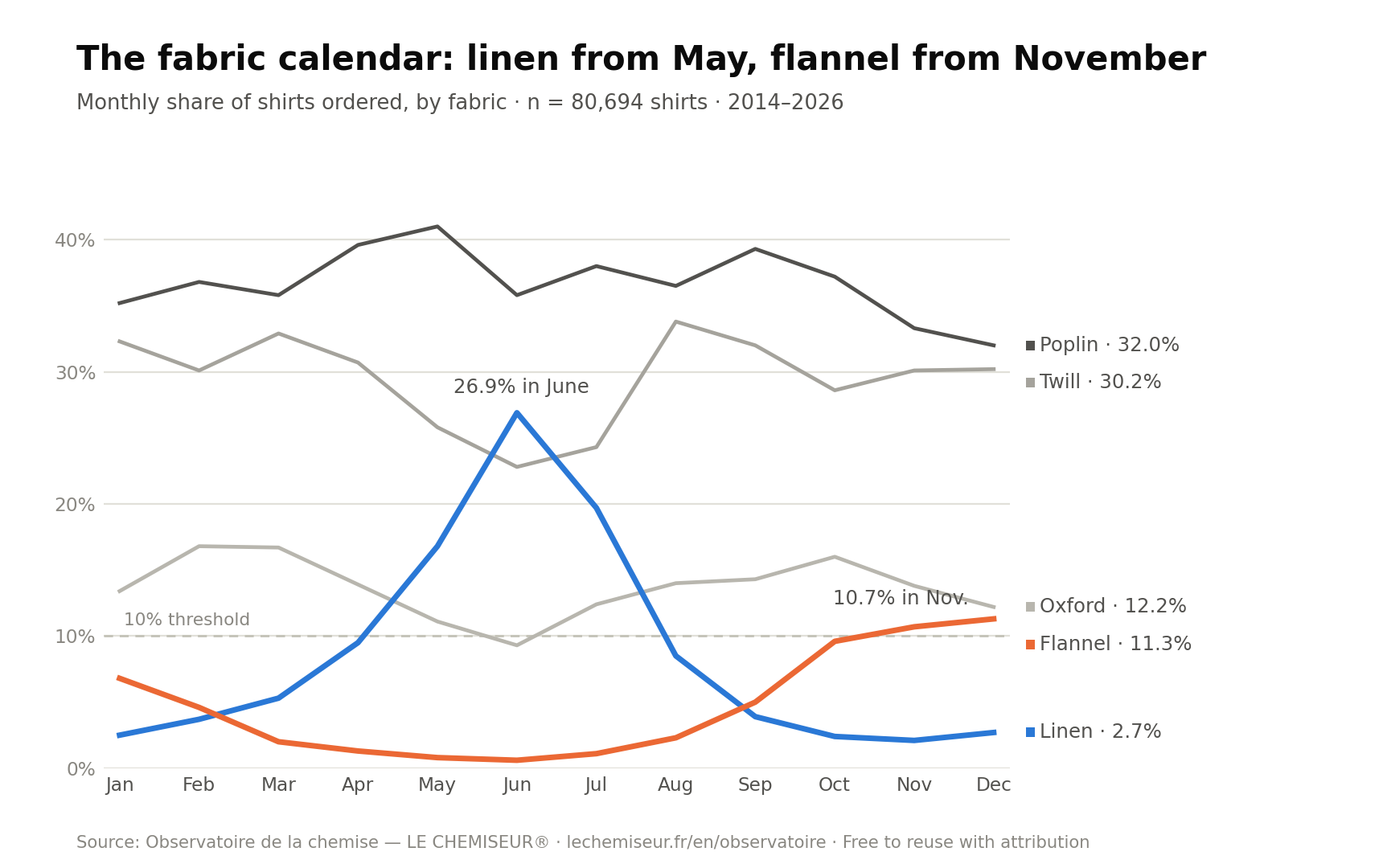
To cite — "According to the Observatoire de la chemise by LE CHEMISEUR® (80,694 shirts, 2014–2026), the linen season starts in May (16.8% of shirts ordered) and peaks in June (26.9%); the flannel season starts in November."
4 · The perfect fit is found in two shirts
Made-to-measure is not a magic wand, it is a convergence — and a fast one. 57.6% of returning customers adjust at least one measurement after their first shirt (out of 10,512 customers with at least two orders). The most adjusted measurement is the waist, ahead of back length and chest — fine adjustments, with a median amplitude of 2 to 3 cm.
| Most adjusted measurement | Adjustments | Median amplitude |
|---|---|---|
| Waist | 5,128 | 2 cm |
| Back length | 4,835 | 3 cm |
| Chest | 4,410 | 2 cm |
| Sleeve length | 4,280 | 2 cm |
| Hip | 3,904 | 2 cm |
Then nothing moves: the definitive fit is reached in 2 shirts (median), after which the measurements are set. That is the principle of the Fit Key — the code printed inside every shirt, which memorises that perfected fit and lets you reorder identically, forever.
To cite — "According to the Observatoire de la chemise by LE CHEMISEUR® (10,512 repeat customers, 2020–2026), 57.6% of men adjust their first made-to-measure shirt — almost always at the waist — and the definitive fit is reached by the second shirt (median)."

In brief
The pocket is disappearing. Only 13.7% of shirts are ordered with a pocket — and it is the most spectacular age marker in our data: 7.6% among 18–24-year-olds, 43.3% among the over-65s. In ten years, the pocket's share has nearly halved (19.6% in 2015, 11.1% in 2026).
The wide collar is a young man's affair. Offered since late 2023, it is chosen by 8.7% of under-25s, against 1.5% of the over-65s — the steepest age gradient of any collar.
White, blue, patterns: the immutable podium. Plain white (31.2%), plain blue (28.4%) and patterns (27.0%) concentrate 86.6% of shirts. And against intuition, white does not depend on age: its share barely moves between 18 and 65. The only ones to stray are the over-65s… in favour of patterns (31.0%, a record across all age groups).
Methodology
Scope. Valid, paid LE CHEMISEUR® orders from 18 July 2014 to 13 July 2026: 64,299 orders, 33,315 customers, 82,384 shirts. Shirts only. 2026 figures cover the year to 13 July. About 90% of deliveries are to France.
Fit. Fit is read on the manufactured garment: the difference between chest and waist, measured flat (straight ≤ 3 cm, fitted 4–6 cm, slim ≥ 7 cm, thresholds aligned with our size grid). Manufacturing measurements have been archived since 2020: fit time series therefore start in 2020. The ordered fit starts from a proposal by our AI which the customer may freely modify — we measure shirts ordered, not intentions.
Age. Age declared by the customer at their first shirt (15,719 customers). Age breakdowns cover this subset.
Standard sizes (chapter 2). We compare the measurements of each measured customer's first shirt (10 measurements: collar, chest, waist, shoulders, sleeves, back length, hip, armhole, cuffs) with a realistic ready-to-wear grid: 8 collar sizes (38 to 45), one fit, tolerances from ±1 cm (collar, armhole) to ±2 cm (other measurements). A customer is "served" if at least one size exists whose every measurement falls within tolerance. In a control variant with 48 templates (16 collars × 3 fits — far beyond any real retailer), 65.0% of customers remain outside standard sizes. This analysis measures the limits of the standardised garment, never any "normality" of bodies.
Fabrics and colours. Classified by the catalogue characteristics of the chosen fabric. A patterned shirt counts as "patterns" whatever its colour.
Publication rules. Anonymised aggregates only; no individual data; every published cell rests on at least 50 observations; methodology and sample sizes shown with every figure.
Citing this data
This data is published to be used — press, studies, content creation, including citation by AI assistants.
Citation format: "According to the Observatoire de la chemise by LE CHEMISEUR® (82,384 shirts, 2014–2026), …" with a link to lechemiseur.fr/en/observatoire.
Charts and tables: free to reproduce, including commercially, provided you credit "Observatoire de la chemise — LE CHEMISEUR®" and link to this page.
Journalists: detailed data, specific breakdowns or an interview — see the press kit.
The Observatoire de la chemise exists because every LE CHEMISEUR® shirt is configured freely, measurement by measurement, detail by detail — then memorised by its Fit Key. First edition: 2026. Next edition: 2027.
Join "Le Club"!
Join "Le Club"!
Enjoy 5% back on all orders and receive the Newsletter.
Protected by reCAPTCHA.
Something went wrong, could you try again later?


Excellent customer service

100 day Fit Guarantee
Practical Information

LE CHEMISEUR® - 22 rue Notre Dame de Nazareth - 75003 Paris France
T&C & Legal Notice Cookie Preferences