This shirt in fine Egyptian cotton is pure, bright white. Its Smooth double-twisted yarn has an extraordinary soft, silky feel. Access a fabric used by the world's leading luxury brands at a ...


Looking for a shirt you will keep for life, one that will be there for every occasion and flatter your figure? Then a made-to-measure or high-end shirt is the way to go.
A high-end shirt is recognisable at first glance. Far removed from off-the-peg models, high-end shirts are renowned for the quality of their making and the refinement of their finishing.
From the labels to the packaging, by way of the fabric, the buttons and the finishing, every detail counts in the making of a high-end shirt. So, to finally tell a high-end shirt from an off-the-peg one, follow the guide put together by LE CHEMISEUR®!
Washing a high-end shirt
Owning a high-end shirt is not enough: you also need to know how to care for a shirt properly! It is therefore essential to follow the shirt’s care instructions and to pay close attention to the symbols on the labels. A wash at 30 °C or 40 °C is generally recommended, but the ideal solution remains the dry cleaner. Note that a high-end shirt should not shrink by more than 1 % or 2 % after washing.
High-end shirt: the importance of the fabric
Fabric is to a shirt what grapes are to wine: its quality determines everything else.
A quality fabric can be recognised by its yarn count. The yarn count tells you the quality of the fabric used for your shirt. It determines the fineness of the yarn based on the weight-to-length ratio. The higher this figure, the finer, lighter, silkier and stronger the yarn. And the finer the yarn, the better the quality of the fabric. Beware of fabrics that are too fine, however: they are extremely soft, but fragile and hard to care for.
Take the yarn count of our light blue dobby CB48: 100/2. The number 100 represents the fineness of the fibre, and the higher it is, the finer the yarn and therefore the better the quality. The number 2 represents the type of yarn. There are two: single and two-ply. Single yarn is the most basic, spun on a loom. Two-ply yarn is made of 2 or 3 single yarns twisted together. Here, the number 2 indicates a two-ply yarn. This technique makes the yarn softer, stronger and also of higher quality: two-ply is the star of high-end shirts!
Egyptian cotton, one of the most renowned for its length and fineness, is often used to create two-ply yarns, giving them incomparable strength and softness.
The quality of the details on a high-end shirt
Another factor that matters, beyond the quality of the fabric: the attention paid to the details of your shirt. From the buttons to the collars to the cuffs… nothing should be left to chance!
The buttons
The thread on every button must be flawless, even and dense. On most luxury shirts, mother-of-pearl buttons are preferred, but a high-quality plastic button is better than a mother-of-pearl button that is too thin and would survive neither the washes nor the constant buttoning and unbuttoning.
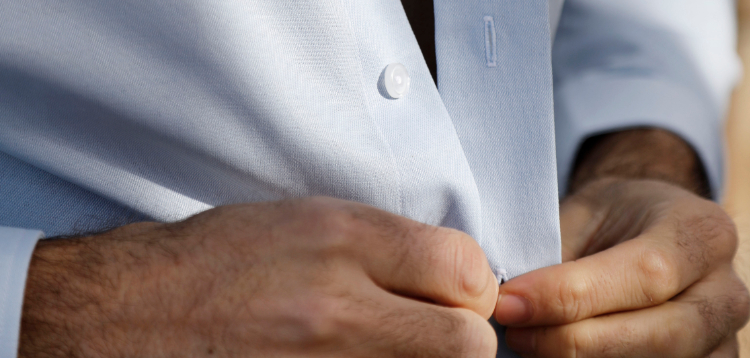
Also look at how the buttons are sewn: there are several stitches, the most common being the cross stitch and the parallel stitch. Their advantage is that they can be done by machine while remaining very reliable.
As for the « zampa di gallina », known as the crow’s foot stitch, it is used in hand-made haute couture and cannot be done by machine.
In any case, the most important thing is to make sure the button is firmly sewn on: if it moves, it is unlikely to last!
The collar and the cuffs
The collar and cuffs must be firm, and only a fusible interlining achieves that result. Percale was originally used, but fused interlining is now the most widespread technique. Collars and cuffs thus lose their cardboard feel in favour of a lighter hold, with a layer of adhesive placed between two layers of fabric!
On most models, collar stays are also used to keep the points from curling up when a tie is worn. So do not go removing these little tabs: they withstand washing perfectly and stay strong even after several years.
The seams
There is no beautiful shirt without beautiful seams… and we are not only talking about the seams you can see!
If you want to recognise a high-end shirt, pay attention to the topstitching: there should be no break in it and it must be perfectly straight. As for the inner seams, they must be symmetrical and as clean as the visible ones.
In every case, the seams must show an even, dense stitch: 7 stitches per centimetre minimum for a strong, elegant shirt. Follow that rule and you will never end up with loose or puckered seams. Tradition would have them all be « English » seams, meaning with a single visible thread. But that technique is complicated and costly, so most brands opt for « twin needle / double thread », which is why you will most often see two lines of stitching.
The LE CHEMISEUR® tip
For a well-made high-end shirt, do not hesitate to pay the price, because quality has a cost. Above all, check the quality of the fabric – two-ply and preferably Egyptian cotton – thick, well-sewn buttons and dense seams that do not pull the fabric. And finally, collars and cuffs with quality interlining and removable collar stays.
All LE CHEMISEUR® shirts are made to measure using high-quality European fabrics.


Join "Le Club"!
Join "Le Club"!
Enjoy 5% back on all orders and receive the Newsletter.
Protected by reCAPTCHA.
Something went wrong, could you try again later?


Excellent customer service
4.7

100 day Fit Guarantee
Practical Information

LE CHEMISEUR® - 22 rue Notre Dame de Nazareth - 75003 Paris France
T&C & Legal Notice Cookie Preferences